SUBHEAD: We should be redefining Energy Security as keeping at least "Some of the Lights On".
By Kris De Decker on 10 December 2018 for Low-Tech Magazine -
(https://www.lowtechmagazine.com/2018/12/keeping-some-of-the-lights-on-redefining-energy-security.html)
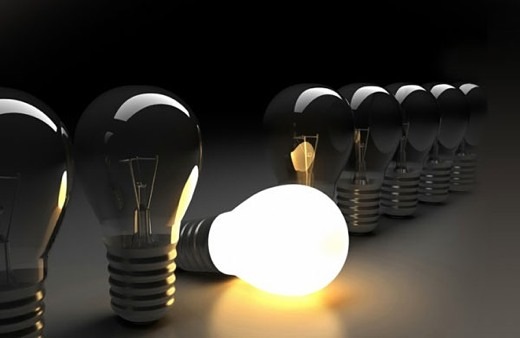
Image above: Keeping some of the lightbulbs on is better than all or nothing. From (http://www.womeninaction.co.za/be-different-to-make-a-difference/).
What is Energy Security?
What does it mean for a society to have “energy security”? Although there are more than forty different definitions of the concept, they all share the fundamental idea that energy supply should always meet energy demand. This also implies that energy supply needs to be constant – there can be no interruptions in the service. [1-4]
For example, the International Energy Agency (IEA) defines energy security as “the uninterrupted availability of energy sources at an affordable price”, the US Department of Energy and Climate Change (DECC) defines the concept as meaning that “the risks of interruption to energy supply are low”, and the EU defines it as a “stable and abundant supply of energy”. [5-7]
Historically, energy security was achieved by securing access to forests or peat bogs for thermal energy, and to human, animal, wind or water power sources for mechanical energy. With the arrival of the Industrial Revolution, energy security came to depend on the supply of fossil fuels.
As a theoretical concept, energy security is most closely related to the oil crises from the 1970s, when embargoes and price manipulations limited oil supply to Western nations.
As a result, most industrialised societies still stockpile oil reserves that are equivalent to several months of consumption.
Although oil remains as vital to industrial economies as it was in the 1970s, mainly for transportation and agriculture, it’s now recognised that energy security in modern societies also depends on other infrastructures, such as those supplying gas, electricity, and even data.
Furthermore, these infrastructures increasingly interconnect and depend on each other.
For example, gas is an important fuel for power production, while the power grid is now required to operate gas pipelines. Power grids are needed to run data networks, and data networks are now needed to run power grids.
This article investigates the concept of energy security by focusing on the power grid, which has become just as vital to industrial societies as oil. Moreover, electrification is seen as a way to decrease dependency on fossil fuels – think electric vehicles, heat pumps, and wind turbines.
The “security” or “reliability” of a power grid can be measured precisely by indicators of continuity such as the “Loss-of-Load Probability” (LOLP), and the “System Average Interruption Duration Index” (SAIDI). Using these indicators, one can only conclude that power grids in industrial societies are very secure.
For example, in Germany, power is available for 99.996% of the time, which corresponds to an interruption in service of less than half an hour per customer per year. [8]
Even the worst performing countries in Europe (Latvia, Poland, Lithuania) have supply shortages of only eight hours per customer per year, which corresponds to a reliability of 99.90%. [8]
The US power grid is in between these values, with supply interruptions of less than four hours per customer per year (99.96% reliability). [9]
How Secure is a Renewable Power Grid?
In the current operation of infrastructures, the paradigm is that consumers could and should have access to as much electricity, gas, oil, data or water as they want, anytime they want it, for as long as they want it.
The only requirement is that they pay the bill. Looking at the power sector, this vision of energy security is quite problematic, for several reasons.
First of all, most energy sources from which electricity is made are finite – and maintaining a steady supply of something that’s finite is of course impossible. In the long run, the strategy to maintain energy security is certainly doomed to fail. In the shorter term, it may disrupt the climate and provoke armed conflicts.
The International Energy Agency (IEA), which was set up following the first oil crisis in the early 1970s, encourages the use of renewable energy sources in order to diversify the energy supply and improve energy security in the long term.
A renewable power system is not dependent on foreign energy imports nor vulnerable to fuel price manipulations – which are the main worries in an energy infrastructure that is largely based on fossil fuels.
Of course, solar panels and wind turbines have limited lifetimes and need to be manufactured, which also requires resources that could come from abroad or which can become depleted. But, once they are installed, renewable power systems are “secure” in a way and for a period of time that fossil fuels (and atomic energy) are not.
Furthermore, solar and wind power provide more security concerning physical failure or sabotage, even more so when renewable power production is decentralised. Renewable power plants also have lower CO2-emissions, and the extreme weather events caused by climate change are a risk to energy security as well.
However, in spite of all these advantages, renewable energy sources pose fundamental challenges to the current understanding of energy security.
Most importantly, the renewable energy sources with the largest potential – sun and wind – are only intermittently available, depending on the weather and the seasons.
This means that solar and wind power don’t match the criterium that all definitions of energy security consider to be essential: the need for an uninterrupted, unlimited supply of power.
The reliability of a power grid with a high share of solar and wind power would be significantly below today’s standards for continuity of service. [10-14]
In such a renewable power grid, a 24/7 power supply can only be maintained at very high costs, because it requires an extensive infrastructure for energy storage, power transmission, and excess generation capacity.
This additional infrastructure risks making a renewable power grid unsustainable, because above a certain threshold, the fossil fuel energy used for building, installing and maintaining this infrastructure becomes higher than the fossil fuel energy saved by the solar panels and the wind turbines.
Intermittency is not the only disadvantage of renewable energy sources. Although many media and environmental organisations have painted a picture of solar and wind power as abundant sources of energy (“The sun delivers more energy to Earth in an hour than the world consumes in a year”), reality is more complex.
The “raw” supply of solar (and wind) energy is enormous indeed.
However, because of their very low power density, to convert this energy supply into a useful form solar panels and wind turbines require magnitudes of order more space and materials compared to thermal power plants – even if the mining and distribution of fuels is included. [15]
Therefore, a renewable power grid cannot guarantee that consumers have access to as much electricity as they want, even if the weather conditions are optimal.
How Secure is an Off-the-Grid Power System?
Today’s energy policies related to electricity try to reconcile three aims: an uninterrupted and limitless supply of power, affordability of electricity prices, and environmental sustainability.
A power grid that is mainly based on fossil fuels and atomic energy cannot achieve the aim of environmental sustainability, and it can only achieve the other goals as long as foreign suppliers do not cut off supplies or raise energy prices (or as long as national or international reserves are not depleted).
However, a renewable power grid cannot reconcile these three goals either. To achieve an unlimited 24/7 supply of power, the infrastructure needs to be oversized, which makes it expensive and unsustainable.
Without that infrastructure, a renewable power grid could be affordable and sustainable, but it could never offer an unlimited 24/7 supply of power.
Consequently, if we want a power infrastructure that is affordable and sustainable, we need to redefine the concept of energy security – and question the criterium of an unlimited and uninterrupted power supply.
If we look beyond the typical large-scale central infrastructures in industrial societies, it becomes clear that not all provisioning systems offer a limitless supply of resources.
Off-the-Grid microgeneration – the local production and storage of electricity using batteries and solar PV panels or wind turbines – is one example.
In principle, off-the-grid systems can be sized in such a way that they are “always on”. This can be done by following the “worst-month method”, which oversizes generation and storage capacity so that supply can meet demand even during the shortest and darkest days of the year.
However, just like in an imaginary large-scale renewable power grid, matching supply to demand at all times makes an off-the-grid system very costly and unsustainable, especially in high seasonality climates. [16-18]
Therefore, most off-the-grid systems are sized according to a method that aims for a compromise between reliability, economic cost and sustainability. The “loss-of-load probability sizing method” specifies a number of days per year that supply does not match demand. [19-21]
n other words, the system is sized, not only according to a projected energy demand, but also according to the available budget and/or the available space.
Sizing an off-the-grid power system in this way generates significant cost reductions, even if “reliability” is reduced just a little bit.
For example, a calculation for an off-the-grid house in Spain shows that decreasing the reliability from 99.75% to 99.00% produces a 60% cost reduction, with similar benefits for sustainability. Supply would be interrupted for 87.6 hours per year, compared to 22 hours in the higher reliability system. [16]
According to the current understanding of energy security, off-the-grid power systems that are sized in this way are a failure: energy supply doesn’t always meet energy demand.
However, off-gridders don’t seem to complain about a lack of energy security, on the contrary. There’s a simple reason for this: they adapt their energy demand to a limited and intermittent power supply.
In their 2015 book Off-the-Grid: Re-Assembling Domestic Life, Phillip Vannini and Jonathan Taggart document their travels across Canada to interview about 100 off-the-grid households. [22]
Among their most important observations is that voluntary off-gridders use less electricity overall and routinely adapt their energy demand to the weather and the seasons.
For example, washing machines, vacuum cleaners, power tools, toasters or videogame consoles are not used at all, or they are only used during periods of abundant energy, when batteries can accommodate no further charge.
If the sky is overcast, off-gridders act differently to draw less power and have some more left over for the day after.
Vannini and Taggart also observe that voluntary off-gridders seem to feel perfectly happy with levels of lighting or heating that are different from the standards that many in the western world have come to expect. Often, this shows itself in concentrating activities around more localised sources of heat and light. [22]
Similar observations can be made in places where people – involuntarily – depend on infrastructures that are not always on.
If centralised water, electricity and data networks are present in less industrialised countries, they are often characterised by regular and irregular interruptions in the supply. [23-25]
However, in spite of the very low reliability of these infrastructures – according to common indicators of continuity – life goes on.
Daily household routines are shaped around disruptions of supply systems, which are viewed as normal and a largely accepted part of life.
For example, if electricity, water or Internet are only available during certain times of the day, household tasks or other activities are planned accordingly. People also use less energy overall: the infrastructure simply doesn’t allow for a resource-intensive lifestyle. [23]
More Reliable, Less Secure?
The very high “reliability” of power grids in industrial societies is justified by calculating the “value of lost load” (VOLL), which compares the financial loss due to power shortages to the extra investment costs to avoid these shortages. [1][10] [26-29]
However, the value of lost load is highly dependent on how society is organised. The more it depends on electricity, the higher the financial losses due to power shortages will be.
Current definitions of energy security consider supply and demand to be unrelated, and focus almost entirely on securing energy supply.
However, alternative forms of power infrastructures like those described above show that people adapt and match their expectations to a power supply that is limited and not always on. In other words, energy security can be improved, not just by increasing reliability, but also by reducing dependency on energy.
Demand and supply are also interlinked, and mutually influence each other, in 24/7 power systems – but with the opposite effect. Just like “unreliable” off-the-grid power infrastructures foster lifestyles that are less dependent on electricity, “reliable” infrastructures foster lifestyles that are increasingly dependent on electricity.
In their 2018 book Infrastructures and Practices: the Dynamics of Demand in Networked Societies, Olivier Coutard and Elizabeth Shove argue that an unlimited and uninterrupted power supply has enabled people in industrial societies to adopt a multitude of power dependent technologies – such as washing machines, air conditioners, refrigerators, automatic doors, or 24/7 mobile internet access – which become “normal” and central to everyday life.
At the same time, alternative ways of doing things – such as washing clothes by hand, storing food without electricity, keeping cool without air-conditioning, or navigating and communicating without mobile phones – have withered away, or are withering away. [30]
As a result, energy security is in fact higher in off-the-grid power systems and “unreliable” central power infrastructures, while industrial societies are the weakest and most fragile in the face of supply interruptions.
What is generally assumed to be a proof of energy security – an unlimited and uninterrupted power supply – is actually making industrial societies ever more vulnerable to supply interruptions: people increasingly lack the skills and the technology to function without a continuous power supply.
Redefining Energy Security
To arrive to a more accurate definition of energy security requires the concept to be defined, not in terms of commodities like kilowatt-hours of electricity, but in terms of energy services, social practices, or basic needs. [1]
People don’t need electricity in itself. What they need, is to store food, wash clothes, open and close doors, communicate with each other, move from one place to another, see in the dark, and so on.
All these things can be achieved either with or without electricity, and in the first case, with more or less electricity.
Defined in this way, energy security is not just about securing the supply of electricity, but also about improving the resilience of the society, so that it becomes less dependent on a continuous supply of power.
This includes the resilience of people (do they have the skills to do things without electricity?), the resilience of devices and technological systems (can they handle an intermittent power supply?), and the resilience of institutions (is it legal to operate a power grid that is not always on?).
Depending on the resilience of the society, a disruption of the power supply may or may not lead to a disruption of energy services or social practices.
For example, although our food distribution system is dependent on a cold chain that requires a continuous power supply, there are many alternatives.
We could adapt refrigerators to an irregular power supply by insulating them much better, we could reintroduce cold cellars (which keep food fresh without electricity), or we could relearn older methods of food storage, like fermentation.
We could also improve people’s skills in terms of fresh cooking, switch to diets based on ingredients that don’t need cold storage, and encourage local daily shopping over weekly trips to large supermarkets.
If we look at energy security in a more holistic way, taking into account both supply and demand, it quickly becomes clear that energy security in industrial societies continues to deteriorate. We keep delegating more and more tasks to machines, computers and large-scale infrastructures, thus increasing our dependency on electricity.
Furthermore, the Internet is becoming just as essential as the power grid, and trends like cloud computing, the Internet of Things, and self-driving cars are all based on several interconnected layers of continuously operating infrastructures.
Because demand and supply influence each other, we come to a counter-intuitive conclusion: to improve energy security, we need to make the power grid less reliable. This would encourage resilience and substitution, and thus make industrial societies less vulnerable to supply interruptions.
Coutard and Shove argue that “it would make sense to pay more attention to opportunities for innovation that are opened when large network systems are weakened and abandoned, or when they become less reliable”. They add that the experiences of voluntary off-gridders “provide some insights into the types of configuration at stake”. [30]
Arguing for a less reliable power supply is sure to be controversial. In fact, “Keeping the lights on” is a phrase that is often used to justify energy reforms such as building more atomic plants, or keeping them in operation past their planned lifetimes.
To achieve real energy security, “keeping the lights on” should be replaced by phrases like “keeping some of the lights on”, “which lights should we turn off next?”, or “what’s wrong with a bit more dark?”. [31]
Obviously, a less reliable energy supply would bring fundamental changes to routines and technologies, whether it is in households, factories, transport systems, or communications networks – but that’s exactly the point. Present ways of life in industrial societies are simply not sustainable.
Sources
[1] Winzer, Christian. "Conceptualizing energy security." Energy policy 46 (2012): 36-48. https://www.repository.cam.ac.uk/bitstream/handle/1810/242060/cwpe1151.pdf?sequence=1&isAllowed=y
[2] Sovacool, Benjamin K., and Ishani Mukherjee. "Conceptualizing and measuring energy security: A synthesized approach." Energy 36.8 (2011): 5343-5355. https://relooney.com/NS4053-Energy/00-Energy-Security_1.pdf
[3] Kruyt, Bert, et al. "Indicators for energy security." Energy policy37.6 (2009): 2166-2181. https://www.sciencedirect.com/science/article/pii/S0301421509000883
[4] Cherp, Aleh, and Jessica Jewell. "The concept of energy security: Beyond the four As." Energy Policy 75 (2014): 415-421. https://www.sciencedirect.com/science/article/pii/S0301421514004960
5] Energy security, International Energy Agency. https://www.iea.org/topics/energysecurity/
[6] Lucas, Javier Noel Valdés, Gonzalo Escribano Francés, and Enrique San Martín González. "Energy security and renewable energy deployment in the EU: Liaisons Dangereuses or Virtuous Circle?." Renewable and Sustainable Energy Reviews 62 (2016): 1032-1046. https://www.researchgate.net/profile/Javier_Valdes4/publication/303361228_Energy_security_and_renewable_energy_deployment_in_the_EU_Liaisons_Dangereuses_or_Virtuous_Circle/links/5a536f45458515e7b72eab26/Energy-security-and-renewable-energy-deployment-in-the-EU-Liaisons-Dangereuses-or-Virtuous-Circle.pdf
[7] Strambo, Claudia, Måns Nilsson, and André Månsson. "Coherent or inconsistent? Assessing energy security and climate policy interaction within the European Union." Energy Research & Social Science 8 (2015): 1-12. https://www.sciencedirect.com/science/article/pii/S221462961500047X
[8] CEER Benchmarking Report 6.1 on the Continuity of Electricity and Gas Supply. Data update 2015/2016. Ref: C18-EQS-86-03. 26-July-2018. Council of European Energy Regulators. https://www.ceer.eu/documents/104400/-/-/963153e6-2f42-78eb-22a4-06f1552dd34c
[9] Average frequency and duration of electric distribution outages vary by states. U.S. Energy Information Administration (EIA). April 5, 2018. https://www.eia.gov/todayinenergy/detail.php?id=35652
[10] Röpke, Luise. "The development of renewable energies and supply security: a trade-off analysis." Energy policy 61 (2013): 1011-1021. https://www.econstor.eu/bitstream/10419/73854/1/IfoWorkingPaper-151.pdf
[11] "Evolutions in energy conservation policies in the time of renewables", Nicola Lablanca, Isabella Maschio, Paolo Bertoldi, ECEEE 2015 Summer Study -- First Fuel Now. https://www.eceee.org/library/conference_proceedings/eceee_Summer_Studies/2015/9-dynamics-of-consumption/evolutions-in-energy-conservation-policies-in-the-time-of-renewables/
[12] “How not to run a modern society on solar and wind power alone”, Kris De Decker, Low-tech Magazine, September 2017.
[13] Nedic, Dusko, et al. Security assessment of future UK electricity scenarios. Tyndall Centre for Climate Change Research, 2005. http://citeseerx.ist.psu.edu/viewdoc/download?doi=10.1.1.461.4834&rep=rep1&type=pdf
[14] Zhou, P., R. Y. Jin, and L. W. Fan. "Reliability and economic evaluation of power system with renewables: A review." Renewable and Sustainable Energy Reviews 58 (2016): 537-547. https://www.sciencedirect.com/science/article/pii/S136403211501727X
[15] Smil, Vaclav. Power density: a key to understanding energy sources and uses. MIT Press, 2015. https://mitpress.mit.edu/books/power-density
[16] Landeira, Cristina Cabo, Ángeles López-Agüera, and Fernando Núñez Sánchez. "Loss of Load Probability method applicability limits as function of consumption types and climate conditions in stand-alone PV systems." (2018). https://www.researchgate.net/profile/Cristina_Cabo2/publication/324080184_Loss_of_Load_Probability_method_applicability_limits_as_function_of_consumption_types_and_climate_conditions_in_stand-alone_PV_systems/links/5abca9fa45851584fa6e1efd/Loss-of-Load-Probability-method-applicability-limits-as-function-of-consumption-types-and-climate-conditions-in-stand-alone-PV-systems.pdf
[17] Singh, S. Sanajaoba, and Eugene Fernandez. "Method for evaluating battery size based on loss of load probability concept for a remote PV system." Power India International Conference (PIICON), 2014 6th IEEE. IEEE, 2014. https://ieeexplore.ieee.org/abstract/document/7117729
[18] How sustainanle is stored sunlight? Kris De Decker, Low-tech Magazine.
[19] Chapman, R. N. "Sizing Handbook for Stand-Alone Photovoltaic." Storage Systems, Sandia Report, SAND87-1087, Albuquerque (1987). https://prod.sandia.gov/techlib-noauth/access-control.cgi/1987/871087.pdf
[20] Posadillo, R., and R. López Luque. "A sizing method for stand-alone PV installations with variable demand." Renewable Energy33.5 (2008): 1049-1055. https://www.sciencedirect.com/science/article/pii/S096014810700184X
[21] Khatib, Tamer, Ibrahim A. Ibrahim, and Azah Mohamed. "A review on sizing methodologies of photovoltaic array and storage battery in a standalone photovoltaic system." Energy Conversion and Management 120 (2016): 430-448. https://staff.najah.edu/media/published_research/2017/01/19/A_review_on_sizing_methodologies_of_photovoltaic_array_and_storage_battery_in_a_standalone_photovoltaic_system.pdf
[22] Vannini, Phillip, and Jonathan Taggart. Off the grid: re-assembling domestic life. Routledge, 2014. http://lifeoffgrid.ca/off-grid-living-the-book/
[23] "Materialising energy and water resources in everyday practices: insights for securing supply systems", Yolande Strengers, Cecily Maller, in "Global Environmental Change 22 (2012), pp. 754-763. http://researchbank.rmit.edu.au/view/rmit%3A17990/n2006038376.pdf
[24] Pillai, N. "Loss of Load Probability of a Power System." (2008). https://mpra.ub.uni-muenchen.de/6953/1/MPRA_paper_6953.pdf
[25] Al-Rubaye, Mohannad Jabbar Mnati, and Alex Van den Bossche. "Decades without a real grid: a living experience in Iraq." International Conference on Sustainable Energy and Environment Sensing (SEES 2018). 2018. https://biblio.ugent.be/publication/8566224
[26] Telson, Michael L. "The economics of alternative levels of reliability for electric power generation systems." The Bell Journal of Economics (1975): 679-694. https://www.jstor.org/stable/3003250
[27] Schröder, Thomas, and Wilhelm Kuckshinrichs. "Value of lost load: an efficient economic indicator for power supply security? A literature review." Frontiers in energy research 3 (2015): 55. https://www.frontiersin.org/articles/10.3389/fenrg.2015.00055/full
[28] Ratha, Anubhav, Emil Iggland, and Goran Andersson. "Value of Lost Load: How much is supply security worth?." Power and Energy Society General Meeting (PES), 2013 IEEE. IEEE, 2013. https://www.ethz.ch/content/dam/ethz/special-interest/itet/institute-eeh/power-systems-dam/documents/SAMA/2012/Ratha-SA-2012.pdf
[29] De Nooij, Michiel, Carl Koopmans, and Carlijn Bijvoet. "The value of supply security: The costs of power interruptions: Economic input for damage reduction and investment in networks." Energy Economics 29.2 (2007): 277-295.
[30] Coutard, Olivier, and Elizabeth Shove. "Infrastructures, practices and the dynamics of demand." Infrastructures in Practice. Routledge, 2018. 10-22. https://www.routledge.com/Infrastructures-in-Practice-The-Dynamics-of-Demand-in-Networked-Societies/Shove-Trentmann/p/book/9781138476165
[31] Demand Dictionary of Phrase and Fable, seventeenth edition. Jenny Rinkinen, Elizabeth Shove, Greg Marsden, The Demand Centre, 2018. http://www.demand.ac.uk/wp-content/uploads/2018/07/Demand-Dictionary.pdf
.
By Kris De Decker on 10 December 2018 for Low-Tech Magazine -
(https://www.lowtechmagazine.com/2018/12/keeping-some-of-the-lights-on-redefining-energy-security.html)
Image above: Keeping some of the lightbulbs on is better than all or nothing. From (http://www.womeninaction.co.za/be-different-to-make-a-difference/).
What is Energy Security?
What does it mean for a society to have “energy security”? Although there are more than forty different definitions of the concept, they all share the fundamental idea that energy supply should always meet energy demand. This also implies that energy supply needs to be constant – there can be no interruptions in the service. [1-4]
For example, the International Energy Agency (IEA) defines energy security as “the uninterrupted availability of energy sources at an affordable price”, the US Department of Energy and Climate Change (DECC) defines the concept as meaning that “the risks of interruption to energy supply are low”, and the EU defines it as a “stable and abundant supply of energy”. [5-7]
Historically, energy security was achieved by securing access to forests or peat bogs for thermal energy, and to human, animal, wind or water power sources for mechanical energy. With the arrival of the Industrial Revolution, energy security came to depend on the supply of fossil fuels.
As a theoretical concept, energy security is most closely related to the oil crises from the 1970s, when embargoes and price manipulations limited oil supply to Western nations.
As a result, most industrialised societies still stockpile oil reserves that are equivalent to several months of consumption.
Although oil remains as vital to industrial economies as it was in the 1970s, mainly for transportation and agriculture, it’s now recognised that energy security in modern societies also depends on other infrastructures, such as those supplying gas, electricity, and even data.
Furthermore, these infrastructures increasingly interconnect and depend on each other.
For example, gas is an important fuel for power production, while the power grid is now required to operate gas pipelines. Power grids are needed to run data networks, and data networks are now needed to run power grids.
This article investigates the concept of energy security by focusing on the power grid, which has become just as vital to industrial societies as oil. Moreover, electrification is seen as a way to decrease dependency on fossil fuels – think electric vehicles, heat pumps, and wind turbines.
The “security” or “reliability” of a power grid can be measured precisely by indicators of continuity such as the “Loss-of-Load Probability” (LOLP), and the “System Average Interruption Duration Index” (SAIDI). Using these indicators, one can only conclude that power grids in industrial societies are very secure.
For example, in Germany, power is available for 99.996% of the time, which corresponds to an interruption in service of less than half an hour per customer per year. [8]
Even the worst performing countries in Europe (Latvia, Poland, Lithuania) have supply shortages of only eight hours per customer per year, which corresponds to a reliability of 99.90%. [8]
The US power grid is in between these values, with supply interruptions of less than four hours per customer per year (99.96% reliability). [9]
How Secure is a Renewable Power Grid?
In the current operation of infrastructures, the paradigm is that consumers could and should have access to as much electricity, gas, oil, data or water as they want, anytime they want it, for as long as they want it.
The only requirement is that they pay the bill. Looking at the power sector, this vision of energy security is quite problematic, for several reasons.
First of all, most energy sources from which electricity is made are finite – and maintaining a steady supply of something that’s finite is of course impossible. In the long run, the strategy to maintain energy security is certainly doomed to fail. In the shorter term, it may disrupt the climate and provoke armed conflicts.
The International Energy Agency (IEA), which was set up following the first oil crisis in the early 1970s, encourages the use of renewable energy sources in order to diversify the energy supply and improve energy security in the long term.
A renewable power system is not dependent on foreign energy imports nor vulnerable to fuel price manipulations – which are the main worries in an energy infrastructure that is largely based on fossil fuels.
Of course, solar panels and wind turbines have limited lifetimes and need to be manufactured, which also requires resources that could come from abroad or which can become depleted. But, once they are installed, renewable power systems are “secure” in a way and for a period of time that fossil fuels (and atomic energy) are not.
Furthermore, solar and wind power provide more security concerning physical failure or sabotage, even more so when renewable power production is decentralised. Renewable power plants also have lower CO2-emissions, and the extreme weather events caused by climate change are a risk to energy security as well.
However, in spite of all these advantages, renewable energy sources pose fundamental challenges to the current understanding of energy security.
Most importantly, the renewable energy sources with the largest potential – sun and wind – are only intermittently available, depending on the weather and the seasons.
This means that solar and wind power don’t match the criterium that all definitions of energy security consider to be essential: the need for an uninterrupted, unlimited supply of power.
The reliability of a power grid with a high share of solar and wind power would be significantly below today’s standards for continuity of service. [10-14]
In such a renewable power grid, a 24/7 power supply can only be maintained at very high costs, because it requires an extensive infrastructure for energy storage, power transmission, and excess generation capacity.
This additional infrastructure risks making a renewable power grid unsustainable, because above a certain threshold, the fossil fuel energy used for building, installing and maintaining this infrastructure becomes higher than the fossil fuel energy saved by the solar panels and the wind turbines.
Intermittency is not the only disadvantage of renewable energy sources. Although many media and environmental organisations have painted a picture of solar and wind power as abundant sources of energy (“The sun delivers more energy to Earth in an hour than the world consumes in a year”), reality is more complex.
The “raw” supply of solar (and wind) energy is enormous indeed.
However, because of their very low power density, to convert this energy supply into a useful form solar panels and wind turbines require magnitudes of order more space and materials compared to thermal power plants – even if the mining and distribution of fuels is included. [15]
Therefore, a renewable power grid cannot guarantee that consumers have access to as much electricity as they want, even if the weather conditions are optimal.
How Secure is an Off-the-Grid Power System?
Today’s energy policies related to electricity try to reconcile three aims: an uninterrupted and limitless supply of power, affordability of electricity prices, and environmental sustainability.
A power grid that is mainly based on fossil fuels and atomic energy cannot achieve the aim of environmental sustainability, and it can only achieve the other goals as long as foreign suppliers do not cut off supplies or raise energy prices (or as long as national or international reserves are not depleted).
However, a renewable power grid cannot reconcile these three goals either. To achieve an unlimited 24/7 supply of power, the infrastructure needs to be oversized, which makes it expensive and unsustainable.
Without that infrastructure, a renewable power grid could be affordable and sustainable, but it could never offer an unlimited 24/7 supply of power.
Consequently, if we want a power infrastructure that is affordable and sustainable, we need to redefine the concept of energy security – and question the criterium of an unlimited and uninterrupted power supply.
If we look beyond the typical large-scale central infrastructures in industrial societies, it becomes clear that not all provisioning systems offer a limitless supply of resources.
Off-the-Grid microgeneration – the local production and storage of electricity using batteries and solar PV panels or wind turbines – is one example.
In principle, off-the-grid systems can be sized in such a way that they are “always on”. This can be done by following the “worst-month method”, which oversizes generation and storage capacity so that supply can meet demand even during the shortest and darkest days of the year.
However, just like in an imaginary large-scale renewable power grid, matching supply to demand at all times makes an off-the-grid system very costly and unsustainable, especially in high seasonality climates. [16-18]
Therefore, most off-the-grid systems are sized according to a method that aims for a compromise between reliability, economic cost and sustainability. The “loss-of-load probability sizing method” specifies a number of days per year that supply does not match demand. [19-21]
n other words, the system is sized, not only according to a projected energy demand, but also according to the available budget and/or the available space.
Sizing an off-the-grid power system in this way generates significant cost reductions, even if “reliability” is reduced just a little bit.
For example, a calculation for an off-the-grid house in Spain shows that decreasing the reliability from 99.75% to 99.00% produces a 60% cost reduction, with similar benefits for sustainability. Supply would be interrupted for 87.6 hours per year, compared to 22 hours in the higher reliability system. [16]
According to the current understanding of energy security, off-the-grid power systems that are sized in this way are a failure: energy supply doesn’t always meet energy demand.
However, off-gridders don’t seem to complain about a lack of energy security, on the contrary. There’s a simple reason for this: they adapt their energy demand to a limited and intermittent power supply.
In their 2015 book Off-the-Grid: Re-Assembling Domestic Life, Phillip Vannini and Jonathan Taggart document their travels across Canada to interview about 100 off-the-grid households. [22]
Among their most important observations is that voluntary off-gridders use less electricity overall and routinely adapt their energy demand to the weather and the seasons.
For example, washing machines, vacuum cleaners, power tools, toasters or videogame consoles are not used at all, or they are only used during periods of abundant energy, when batteries can accommodate no further charge.
If the sky is overcast, off-gridders act differently to draw less power and have some more left over for the day after.
Vannini and Taggart also observe that voluntary off-gridders seem to feel perfectly happy with levels of lighting or heating that are different from the standards that many in the western world have come to expect. Often, this shows itself in concentrating activities around more localised sources of heat and light. [22]
Similar observations can be made in places where people – involuntarily – depend on infrastructures that are not always on.
If centralised water, electricity and data networks are present in less industrialised countries, they are often characterised by regular and irregular interruptions in the supply. [23-25]
However, in spite of the very low reliability of these infrastructures – according to common indicators of continuity – life goes on.
Daily household routines are shaped around disruptions of supply systems, which are viewed as normal and a largely accepted part of life.
For example, if electricity, water or Internet are only available during certain times of the day, household tasks or other activities are planned accordingly. People also use less energy overall: the infrastructure simply doesn’t allow for a resource-intensive lifestyle. [23]
More Reliable, Less Secure?
The very high “reliability” of power grids in industrial societies is justified by calculating the “value of lost load” (VOLL), which compares the financial loss due to power shortages to the extra investment costs to avoid these shortages. [1][10] [26-29]
However, the value of lost load is highly dependent on how society is organised. The more it depends on electricity, the higher the financial losses due to power shortages will be.
Current definitions of energy security consider supply and demand to be unrelated, and focus almost entirely on securing energy supply.
However, alternative forms of power infrastructures like those described above show that people adapt and match their expectations to a power supply that is limited and not always on. In other words, energy security can be improved, not just by increasing reliability, but also by reducing dependency on energy.
Demand and supply are also interlinked, and mutually influence each other, in 24/7 power systems – but with the opposite effect. Just like “unreliable” off-the-grid power infrastructures foster lifestyles that are less dependent on electricity, “reliable” infrastructures foster lifestyles that are increasingly dependent on electricity.
In their 2018 book Infrastructures and Practices: the Dynamics of Demand in Networked Societies, Olivier Coutard and Elizabeth Shove argue that an unlimited and uninterrupted power supply has enabled people in industrial societies to adopt a multitude of power dependent technologies – such as washing machines, air conditioners, refrigerators, automatic doors, or 24/7 mobile internet access – which become “normal” and central to everyday life.
At the same time, alternative ways of doing things – such as washing clothes by hand, storing food without electricity, keeping cool without air-conditioning, or navigating and communicating without mobile phones – have withered away, or are withering away. [30]
As a result, energy security is in fact higher in off-the-grid power systems and “unreliable” central power infrastructures, while industrial societies are the weakest and most fragile in the face of supply interruptions.
What is generally assumed to be a proof of energy security – an unlimited and uninterrupted power supply – is actually making industrial societies ever more vulnerable to supply interruptions: people increasingly lack the skills and the technology to function without a continuous power supply.
Redefining Energy Security
To arrive to a more accurate definition of energy security requires the concept to be defined, not in terms of commodities like kilowatt-hours of electricity, but in terms of energy services, social practices, or basic needs. [1]
People don’t need electricity in itself. What they need, is to store food, wash clothes, open and close doors, communicate with each other, move from one place to another, see in the dark, and so on.
All these things can be achieved either with or without electricity, and in the first case, with more or less electricity.
Defined in this way, energy security is not just about securing the supply of electricity, but also about improving the resilience of the society, so that it becomes less dependent on a continuous supply of power.
This includes the resilience of people (do they have the skills to do things without electricity?), the resilience of devices and technological systems (can they handle an intermittent power supply?), and the resilience of institutions (is it legal to operate a power grid that is not always on?).
Depending on the resilience of the society, a disruption of the power supply may or may not lead to a disruption of energy services or social practices.
For example, although our food distribution system is dependent on a cold chain that requires a continuous power supply, there are many alternatives.
We could adapt refrigerators to an irregular power supply by insulating them much better, we could reintroduce cold cellars (which keep food fresh without electricity), or we could relearn older methods of food storage, like fermentation.
We could also improve people’s skills in terms of fresh cooking, switch to diets based on ingredients that don’t need cold storage, and encourage local daily shopping over weekly trips to large supermarkets.
If we look at energy security in a more holistic way, taking into account both supply and demand, it quickly becomes clear that energy security in industrial societies continues to deteriorate. We keep delegating more and more tasks to machines, computers and large-scale infrastructures, thus increasing our dependency on electricity.
Furthermore, the Internet is becoming just as essential as the power grid, and trends like cloud computing, the Internet of Things, and self-driving cars are all based on several interconnected layers of continuously operating infrastructures.
Because demand and supply influence each other, we come to a counter-intuitive conclusion: to improve energy security, we need to make the power grid less reliable. This would encourage resilience and substitution, and thus make industrial societies less vulnerable to supply interruptions.
Coutard and Shove argue that “it would make sense to pay more attention to opportunities for innovation that are opened when large network systems are weakened and abandoned, or when they become less reliable”. They add that the experiences of voluntary off-gridders “provide some insights into the types of configuration at stake”. [30]
Arguing for a less reliable power supply is sure to be controversial. In fact, “Keeping the lights on” is a phrase that is often used to justify energy reforms such as building more atomic plants, or keeping them in operation past their planned lifetimes.
To achieve real energy security, “keeping the lights on” should be replaced by phrases like “keeping some of the lights on”, “which lights should we turn off next?”, or “what’s wrong with a bit more dark?”. [31]
Obviously, a less reliable energy supply would bring fundamental changes to routines and technologies, whether it is in households, factories, transport systems, or communications networks – but that’s exactly the point. Present ways of life in industrial societies are simply not sustainable.
Sources
[1] Winzer, Christian. "Conceptualizing energy security." Energy policy 46 (2012): 36-48. https://www.repository.cam.ac.uk/bitstream/handle/1810/242060/cwpe1151.pdf?sequence=1&isAllowed=y
[2] Sovacool, Benjamin K., and Ishani Mukherjee. "Conceptualizing and measuring energy security: A synthesized approach." Energy 36.8 (2011): 5343-5355. https://relooney.com/NS4053-Energy/00-Energy-Security_1.pdf
[3] Kruyt, Bert, et al. "Indicators for energy security." Energy policy37.6 (2009): 2166-2181. https://www.sciencedirect.com/science/article/pii/S0301421509000883
[4] Cherp, Aleh, and Jessica Jewell. "The concept of energy security: Beyond the four As." Energy Policy 75 (2014): 415-421. https://www.sciencedirect.com/science/article/pii/S0301421514004960
5] Energy security, International Energy Agency. https://www.iea.org/topics/energysecurity/
[6] Lucas, Javier Noel Valdés, Gonzalo Escribano Francés, and Enrique San Martín González. "Energy security and renewable energy deployment in the EU: Liaisons Dangereuses or Virtuous Circle?." Renewable and Sustainable Energy Reviews 62 (2016): 1032-1046. https://www.researchgate.net/profile/Javier_Valdes4/publication/303361228_Energy_security_and_renewable_energy_deployment_in_the_EU_Liaisons_Dangereuses_or_Virtuous_Circle/links/5a536f45458515e7b72eab26/Energy-security-and-renewable-energy-deployment-in-the-EU-Liaisons-Dangereuses-or-Virtuous-Circle.pdf
[7] Strambo, Claudia, Måns Nilsson, and André Månsson. "Coherent or inconsistent? Assessing energy security and climate policy interaction within the European Union." Energy Research & Social Science 8 (2015): 1-12. https://www.sciencedirect.com/science/article/pii/S221462961500047X
[8] CEER Benchmarking Report 6.1 on the Continuity of Electricity and Gas Supply. Data update 2015/2016. Ref: C18-EQS-86-03. 26-July-2018. Council of European Energy Regulators. https://www.ceer.eu/documents/104400/-/-/963153e6-2f42-78eb-22a4-06f1552dd34c
[9] Average frequency and duration of electric distribution outages vary by states. U.S. Energy Information Administration (EIA). April 5, 2018. https://www.eia.gov/todayinenergy/detail.php?id=35652
[10] Röpke, Luise. "The development of renewable energies and supply security: a trade-off analysis." Energy policy 61 (2013): 1011-1021. https://www.econstor.eu/bitstream/10419/73854/1/IfoWorkingPaper-151.pdf
[11] "Evolutions in energy conservation policies in the time of renewables", Nicola Lablanca, Isabella Maschio, Paolo Bertoldi, ECEEE 2015 Summer Study -- First Fuel Now. https://www.eceee.org/library/conference_proceedings/eceee_Summer_Studies/2015/9-dynamics-of-consumption/evolutions-in-energy-conservation-policies-in-the-time-of-renewables/
[12] “How not to run a modern society on solar and wind power alone”, Kris De Decker, Low-tech Magazine, September 2017.
[13] Nedic, Dusko, et al. Security assessment of future UK electricity scenarios. Tyndall Centre for Climate Change Research, 2005. http://citeseerx.ist.psu.edu/viewdoc/download?doi=10.1.1.461.4834&rep=rep1&type=pdf
[14] Zhou, P., R. Y. Jin, and L. W. Fan. "Reliability and economic evaluation of power system with renewables: A review." Renewable and Sustainable Energy Reviews 58 (2016): 537-547. https://www.sciencedirect.com/science/article/pii/S136403211501727X
[15] Smil, Vaclav. Power density: a key to understanding energy sources and uses. MIT Press, 2015. https://mitpress.mit.edu/books/power-density
[16] Landeira, Cristina Cabo, Ángeles López-Agüera, and Fernando Núñez Sánchez. "Loss of Load Probability method applicability limits as function of consumption types and climate conditions in stand-alone PV systems." (2018). https://www.researchgate.net/profile/Cristina_Cabo2/publication/324080184_Loss_of_Load_Probability_method_applicability_limits_as_function_of_consumption_types_and_climate_conditions_in_stand-alone_PV_systems/links/5abca9fa45851584fa6e1efd/Loss-of-Load-Probability-method-applicability-limits-as-function-of-consumption-types-and-climate-conditions-in-stand-alone-PV-systems.pdf
[17] Singh, S. Sanajaoba, and Eugene Fernandez. "Method for evaluating battery size based on loss of load probability concept for a remote PV system." Power India International Conference (PIICON), 2014 6th IEEE. IEEE, 2014. https://ieeexplore.ieee.org/abstract/document/7117729
[18] How sustainanle is stored sunlight? Kris De Decker, Low-tech Magazine.
[19] Chapman, R. N. "Sizing Handbook for Stand-Alone Photovoltaic." Storage Systems, Sandia Report, SAND87-1087, Albuquerque (1987). https://prod.sandia.gov/techlib-noauth/access-control.cgi/1987/871087.pdf
[20] Posadillo, R., and R. López Luque. "A sizing method for stand-alone PV installations with variable demand." Renewable Energy33.5 (2008): 1049-1055. https://www.sciencedirect.com/science/article/pii/S096014810700184X
[21] Khatib, Tamer, Ibrahim A. Ibrahim, and Azah Mohamed. "A review on sizing methodologies of photovoltaic array and storage battery in a standalone photovoltaic system." Energy Conversion and Management 120 (2016): 430-448. https://staff.najah.edu/media/published_research/2017/01/19/A_review_on_sizing_methodologies_of_photovoltaic_array_and_storage_battery_in_a_standalone_photovoltaic_system.pdf
[22] Vannini, Phillip, and Jonathan Taggart. Off the grid: re-assembling domestic life. Routledge, 2014. http://lifeoffgrid.ca/off-grid-living-the-book/
[23] "Materialising energy and water resources in everyday practices: insights for securing supply systems", Yolande Strengers, Cecily Maller, in "Global Environmental Change 22 (2012), pp. 754-763. http://researchbank.rmit.edu.au/view/rmit%3A17990/n2006038376.pdf
[24] Pillai, N. "Loss of Load Probability of a Power System." (2008). https://mpra.ub.uni-muenchen.de/6953/1/MPRA_paper_6953.pdf
[25] Al-Rubaye, Mohannad Jabbar Mnati, and Alex Van den Bossche. "Decades without a real grid: a living experience in Iraq." International Conference on Sustainable Energy and Environment Sensing (SEES 2018). 2018. https://biblio.ugent.be/publication/8566224
[26] Telson, Michael L. "The economics of alternative levels of reliability for electric power generation systems." The Bell Journal of Economics (1975): 679-694. https://www.jstor.org/stable/3003250
[27] Schröder, Thomas, and Wilhelm Kuckshinrichs. "Value of lost load: an efficient economic indicator for power supply security? A literature review." Frontiers in energy research 3 (2015): 55. https://www.frontiersin.org/articles/10.3389/fenrg.2015.00055/full
[28] Ratha, Anubhav, Emil Iggland, and Goran Andersson. "Value of Lost Load: How much is supply security worth?." Power and Energy Society General Meeting (PES), 2013 IEEE. IEEE, 2013. https://www.ethz.ch/content/dam/ethz/special-interest/itet/institute-eeh/power-systems-dam/documents/SAMA/2012/Ratha-SA-2012.pdf
[29] De Nooij, Michiel, Carl Koopmans, and Carlijn Bijvoet. "The value of supply security: The costs of power interruptions: Economic input for damage reduction and investment in networks." Energy Economics 29.2 (2007): 277-295.
[30] Coutard, Olivier, and Elizabeth Shove. "Infrastructures, practices and the dynamics of demand." Infrastructures in Practice. Routledge, 2018. 10-22. https://www.routledge.com/Infrastructures-in-Practice-The-Dynamics-of-Demand-in-Networked-Societies/Shove-Trentmann/p/book/9781138476165
[31] Demand Dictionary of Phrase and Fable, seventeenth edition. Jenny Rinkinen, Elizabeth Shove, Greg Marsden, The Demand Centre, 2018. http://www.demand.ac.uk/wp-content/uploads/2018/07/Demand-Dictionary.pdf
.